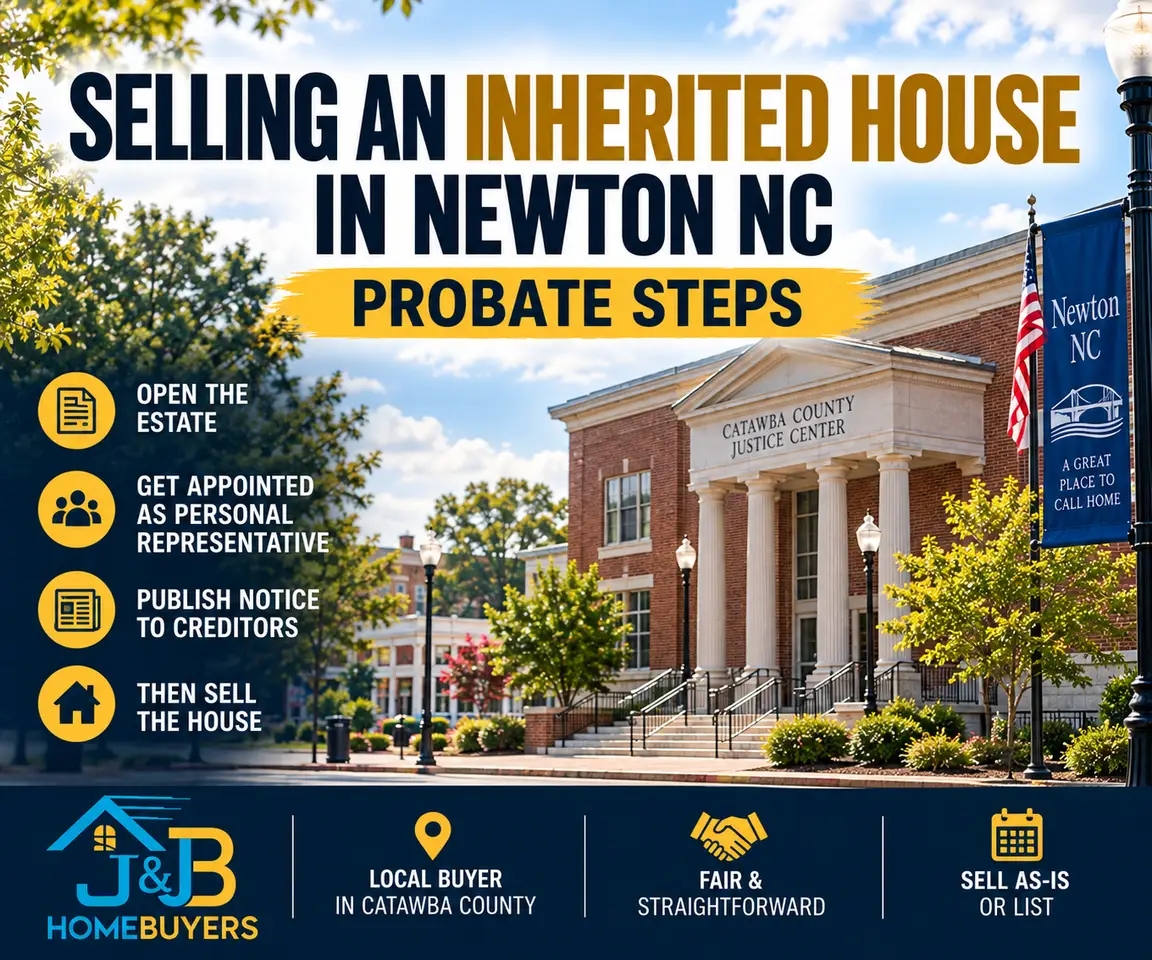


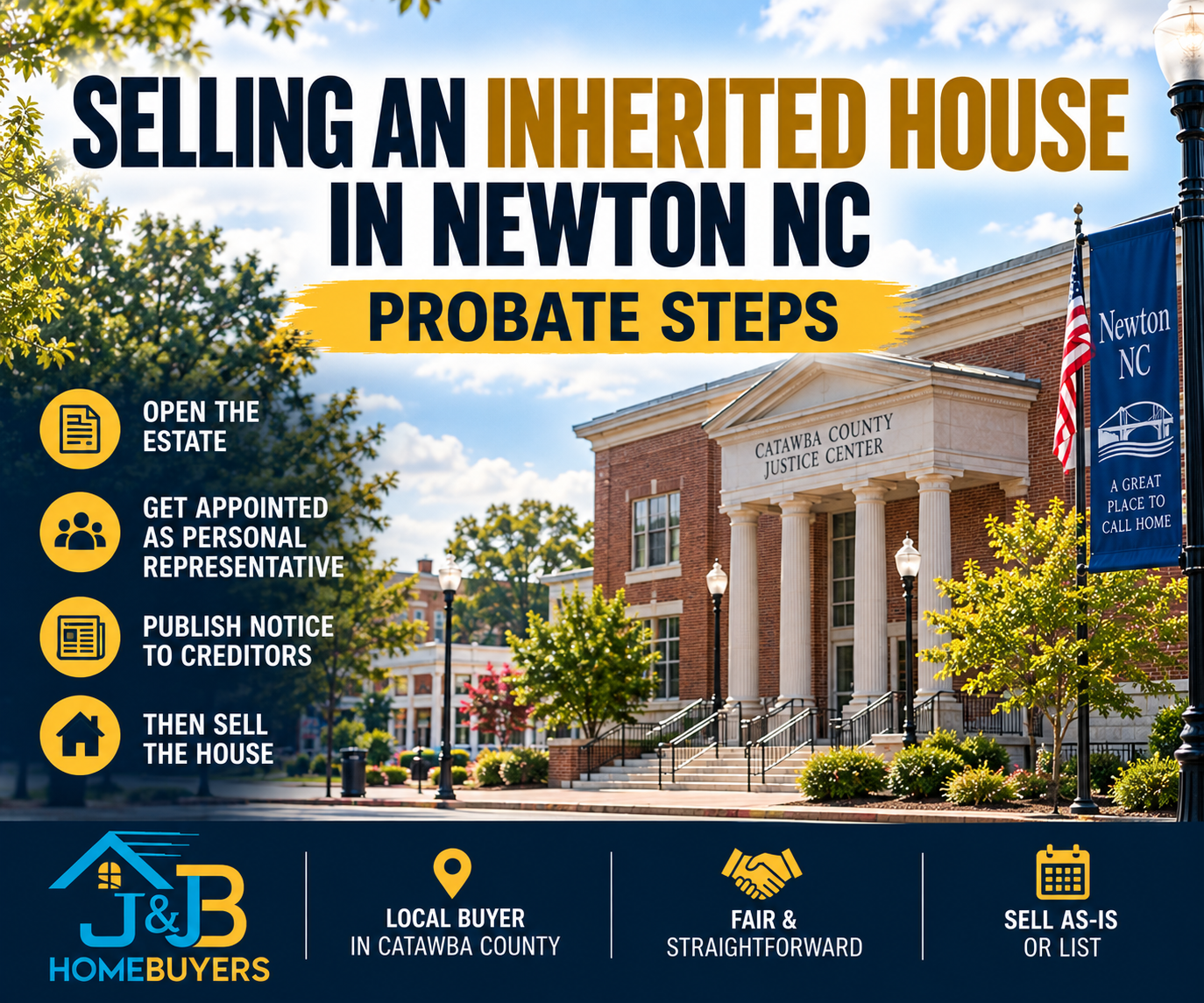
Quick answer: To sell an inherited house in Newton NC, someone usually has to open an estate with the Catawba County Clerk of Superior Court at the Justice Center in Newton, get appointed as personal representative, and publish a notice to creditors. Once that person has authority, the house can be sold by listing it or by selling it as-is for cash, with the personal representative signing the deed when North Carolina law requires it.
If you are trying to figure out how to go about selling an inherited house in Newton NC, you are probably juggling grief, paperwork, and a house that still has someone else’s life inside it. This guide walks through the probate steps at the Catawba County courthouse in Newton in plain English, so you know what comes first and what can wait.
We are J&B Homebuyers, a local cash buyer based in Shelby. We buy houses across Catawba County, including in town and out in the county. You can read more about how we work on our sell my house fast in Newton NC page.
Step One: Figure Out Who Has the Authority to Sell
A house does not sell itself after someone passes. Someone has to have legal authority to sign. In North Carolina that usually means one of these situations:
- There is a will. The will names an executor. That person applies to the Clerk of Superior Court to be appointed and receives “letters testamentary.”
- There is no will. State law decides who inherits. A family member applies to be appointed administrator and receives “letters of administration.”
- The house was already titled differently. Some homes pass outside of probate, for example when a deed gives a right of survivorship. A closing attorney can tell you by looking at the deed.
Even when heirs inherit the house directly, North Carolina has a rule that often catches families off guard. Under G.S. 28A-17-12, if the estate publishes its notice to creditors within two years of the death, a sale by the heirs can be void as to creditors and the personal representative unless the personal representative joins in the sale. In plain terms: during that window, the closing attorney will usually want the personal representative to sign the deed too. That is one big reason most families open an estate before they sell.
Probate Steps at the Catawba County Courthouse in Newton
Estates in Catawba County are handled by the Clerk of Superior Court, Estates Division. The office is in the Catawba County Justice Center at 100 Government Drive in Newton. The Clerk’s office is part of the North Carolina court system, not a county government department. It is a good idea to call ahead before you go, since requirements and forms do change.
Here is how the process generally runs:
- Gather the basics. You will need the original will if there is one, a certified copy of the death certificate, and a rough list of what the person owned and owed.
- Apply to be the personal representative. The application is filed with the Clerk in the county where the person lived. The common state forms are AOC-E-201 when there is a will and AOC-E-202 when there is not.
- Get your letters. Once the Clerk approves you, you receive letters that prove you can act for the estate. Banks, insurance companies, and closing attorneys will ask for copies.
- Publish the notice to creditors. The notice runs in a qualified newspaper once a week for four weeks in a row. The deadline it gives for creditors to file claims must be at least three months after the first publication. Known creditors also have to get notice directly.
- File the inventory. The personal representative lists the estate’s assets, including the house, and files it with the Clerk within the time the statute sets (generally about three months after appointment).
- Pay debts, sell assets if needed, and file accountings. The Estates Division reviews the accountings before the estate can be closed.
If you want a checklist of the paperwork, our post on documents needed to sell a house in NC is a good companion to this one.
How Long Does It Take?
There is no single answer. The creditor period alone runs at least three months from first publication. Simple estates with one heir and no fights can move along steadily. Estates with several heirs, missing paperwork, or a will that someone questions take longer. The good news is you usually do not have to wait for the estate to be completely closed to sell the house. Once the personal representative has letters, the closing attorney can often move forward with the right signatures in place.
If several siblings inherit together, take a look at our guide on selling a house with multiple heirs. The same North Carolina rules apply in Newton as in Charlotte.
Your Options for the House
Once you know who can sign, the real question is what to do with the house. Here is an honest side-by-side look.
| Option | Best for | Trade-offs |
|---|---|---|
| Keep the house | An heir who wants to live there or rent it out | Other heirs may need to be bought out. Taxes, insurance, and upkeep continue. |
| List with a real estate agent | Houses in good shape, families with time | Usually the highest price. Requires cleaning out, repairs, showings, and commissions. Buyer financing can fall through. |
| Sell as-is to a cash buyer | Dated or damaged houses, out-of-town heirs, houses full of belongings | Faster and simpler, but the price will usually be lower than a fixed-up retail sale. |
| Sell to a family member | When someone in the family wants it | Needs agreement from all heirs and a fair price everyone accepts. |
One thing to know about disclosure: North Carolina’s Residential Property Disclosure Act has a narrow exemption for transfers by a fiduciary in the course of administering a decedent’s estate. Whether it applies to your sale depends on who is selling and how. Ask your attorney rather than assuming.
Taxes are another question we hear a lot. We are not tax advisors, but our article on capital gains tax on inherited property in NC explains the general idea so you can have a better conversation with your CPA.
What Is Local About Selling an Estate House in Newton
Newton is the county seat of Catawba County, so the court business happens right in town. Folks sometimes get turned around because the old 1924 courthouse on the square downtown is not where you file anymore. That beautiful granite building is now the History Museum of Catawba County. Estate filings go to the Justice Center on Government Drive.
A lot of estate homes we see around Newton are older brick ranches and frame houses on established streets near downtown, plus houses out in the county on larger lots, some with outbuildings or a well and septic. Those rural properties can take a little more work at closing, like confirming where the property lines are or how the septic is permitted. None of that stops a sale. It just means you want a closing attorney who knows Catawba County, and we always use a North Carolina real estate attorney for our closings.
When a Cash Sale Makes Sense, and When It Doesn’t
We want to be straight with you. A cash sale is not the right move for every estate.
A cash sale often makes sense when:
- The house needs a roof, HVAC, plumbing, or other work the heirs cannot or do not want to pay for.
- The house is still full of furniture and belongings, and no one has time to clear it.
- Heirs live far away or disagree about spending money on repairs.
- The estate needs to stop paying taxes, insurance, and utilities on an empty house.
- You want a firm closing date you choose, without showings or a buyer’s loan falling through.
Listing with an agent is probably better when:
- The house is in good, move-in ready shape.
- The heirs agree, have time, and do not mind a few months of showings.
- Getting top dollar matters more than speed or convenience.
If listing will get your family more money, we will tell you so. When we make an offer, Joshua or Jessica walks the house in person first. We buy as-is, you can leave behind what you do not want, there are no commissions, and we cover normal closing costs. If you want to understand what “as-is” really means, read what as-is means when selling an NC house for cash.
Frequently Asked Questions
Do I have to go through probate to sell an inherited house in Newton NC?
Usually, yes, or at least someone has to be appointed as personal representative. North Carolina’s G.S. 28A-17-12 means that if a notice to creditors is published within two years of the death, the personal representative generally needs to join in a sale by the heirs. Some homes pass outside probate, such as with a survivorship deed, so have a closing attorney review the deed.
Where do I file probate in Catawba County?
Estates are handled by the Clerk of Superior Court, Estates Division, at the Catawba County Justice Center, 100 Government Drive, Newton. Call ahead to confirm current forms, fees, and hours.
Can I sell the house before the estate is closed?
Often, yes. Once the personal representative has letters from the Clerk, the house can usually be sold with the right signatures, even though the estate stays open for creditor claims and accountings. Your attorney will confirm what is needed for your specific estate.
How long is the creditor period in North Carolina?
The notice to creditors is published once a week for four weeks, and the claims deadline must be at least three months after the first publication date. Known creditors must also receive notice directly.
Do I have to clean out the house before selling to J&B Homebuyers?
No. We buy houses as-is, including with furniture and belongings left inside. Take what matters to your family and leave the rest.
If you are handling an estate in Newton or anywhere in Catawba County and want a straight answer about your options, call or text Joshua or Jessica at (704) 286-9391. We will walk the house, give you a no-pressure offer, and tell you honestly if listing makes more sense. Learn more on our Newton NC cash home buyer page.
This article is general information, not legal or financial advice. Every situation is different, so talk to a North Carolina attorney (and a tax or financial professional where money is involved) before you make decisions.