


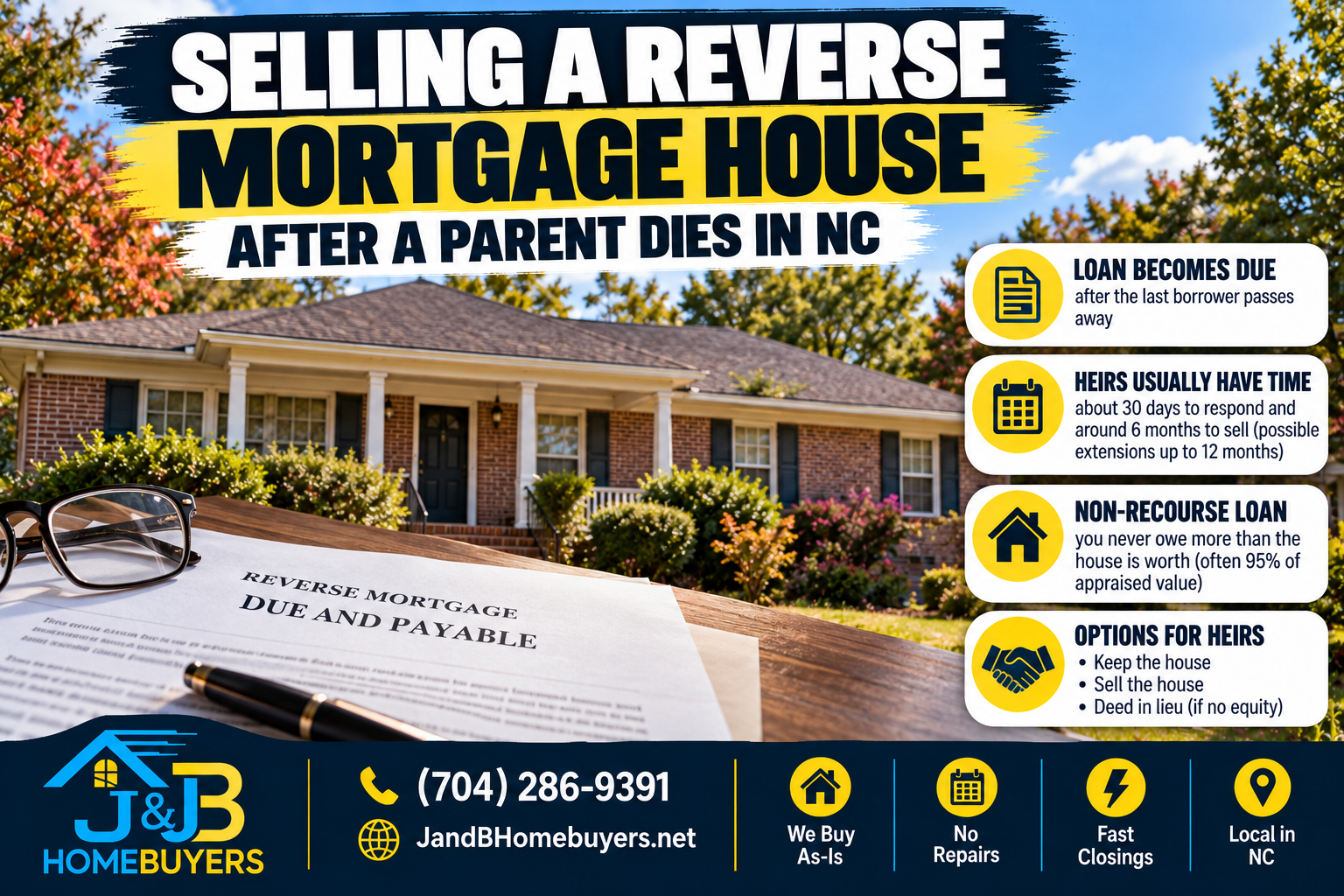
Quick answer: When the last borrower on a reverse mortgage (HECM) dies, the loan becomes due and payable. Heirs typically get about 30 days to tell the servicer their plan and around six months to sell or pay off the loan, with possible extensions that can stretch to about 12 months. Because HECMs are non-recourse, heirs can generally satisfy the loan by paying the lesser of the balance or 95% of the appraised value, and they never owe more than the house is worth.
Selling a reverse mortgage house after a parent dies in NC comes with a clock that a regular inherited house doesn’t have. Within weeks of the funeral, a letter arrives from a servicer you may have never heard of saying the loan is “due and payable.” It is easy to panic. Take a breath. The rules for most reverse mortgages are actually fairly protective of families, as long as you stay in contact with the servicer and keep moving.
We are J&B Homebuyers, a local cash home buyer in Shelby, and we buy houses in Cleveland, Gaston, Catawba, Lincoln, and Mecklenburg counties. You can read about how we work on our sell my house fast in Shelby NC page. This article explains how the reverse mortgage rules generally work so you can make a calm decision.
What “Due and Payable” Means
Most reverse mortgages are Home Equity Conversion Mortgages, or HECMs, insured by the FHA. While your parent lived in the home, they did not have to make monthly payments. Interest and mortgage insurance were added to the loan balance over time instead.
When the last surviving borrower dies, the loan generally becomes due. Important exception: if your parent had a spouse who was not on the loan, that spouse may qualify as an “eligible non-borrowing spouse” and may be able to stay in the home. If that applies to your family, talk to the servicer and an attorney before doing anything else.
The Timeline Heirs Usually Face
| Stage | What generally happens | What you should do |
|---|---|---|
| Servicer learns of the death | The servicer sends a due-and-payable (demand) letter to the property and known heirs. | Notify the servicer promptly and send a death certificate. |
| About 30 days | Heirs are asked to say what they plan to do: pay off, sell, or sign a deed in lieu. | Reply in writing. Ask for a payoff statement. |
| About 6 months | HUD rules generally expect the servicer to start foreclosure within six months of the due date unless more time is approved. | Show progress, like a listing agreement or sales contract. |
| Up to about 12 months | Servicers can request extensions, commonly described as two 90-day extensions, if heirs are actively selling or refinancing. | Ask in writing. Extensions are not automatic. |
Exact deadlines depend on your parent’s loan and the servicer’s letters, so read every notice closely. Interest keeps adding up during this time, and property taxes, homeowners insurance, and upkeep still need to be paid.
The 95% Rule and Why Non-Recourse Matters
This is the most important thing to understand. A HECM is a non-recourse loan. That means the house is the only thing securing the debt. If the loan balance has grown bigger than the house is worth, the heirs and the estate are not personally on the hook for the difference. FHA mortgage insurance covers the shortfall.
HUD guidance also says that when a HECM is due and payable, the estate or heirs can satisfy the loan by paying the lesser of:
- the full loan balance, or
- 95% of the current appraised value of the home.
Here is what that means in real life:
- If the house is worth more than the loan, you can sell it, pay off the loan, and the remaining equity goes to the estate or heirs.
- If the loan is bigger than the house is worth, heirs who want to keep the house can generally pay 95% of the appraised value. If no one wants the house, it can be sold or deeded back to the lender, and the family does not owe the difference.
When the house is “underwater,” the servicer will usually order its own appraisal and approve the sale price. A sale in that situation is more like a short sale and takes more paperwork.
Your Options as an Heir
Keep the house
Pay off the loan with your own funds or a new mortgage. If the balance is higher than the value, ask about paying 95% of the appraised value.
Sell the house
Listing with an agent works well if the house is in good shape and there is equity. A cash sale can work when the house needs repairs or time is tight. Either way, the closing attorney pays off the servicer at closing.
Deed in lieu of foreclosure
If there is no equity and no one wants the house, the estate or heirs can sign the house over to the lender. The lender usually requires the house to be emptied and broom-swept, with no other liens on the title. Some servicers offer a “cash for keys” incentive for completing a deed in lieu or short sale, but it is optional for the servicer, so ask.
Do nothing
If heirs do not respond, the lender eventually forecloses. Because the loan is non-recourse, the family usually does not owe a deficiency, but any equity that could have gone to the estate may be lost. Communicating is almost always better than going silent.
Probate Still Matters in North Carolina
The servicer will usually want proof of who has authority to act for your parent’s estate. In North Carolina that typically means someone is appointed as personal representative by the Clerk of Superior Court in the county where your parent lived. For our area, that’s the courthouse in Shelby for Cleveland County, Gastonia for Gaston, Newton for Catawba, Lincolnton for Lincoln, and Charlotte for Mecklenburg.
Start probate early. It can take some time to get letters issued, and that time comes out of your reverse mortgage window. If several siblings inherit together, the attorney may also need everyone’s signatures. Our guide to avoiding probate delays in NC has tips that help here, and our article on selling an inherited house in Charlotte covers the bigger picture.
What Is Local About Reverse Mortgage Houses in Our Area
A lot of the reverse mortgage houses we see belonged to parents who lived in the same home for decades. In Cleveland County that might be a brick ranch outside Shelby or a farmhouse on a few acres. In Charlotte it might be a 1950s or 1960s home in an older neighborhood that has seen big changes around it. Long ownership often means the house is solid but dated, with original kitchens, older roofs, and aging HVAC.
Many families we talk to live outside the area and are handling the house from a distance. The reverse mortgage clock makes that harder. The key is to get the servicer, the probate attorney, and a plan for the house all lined up in the first month or two.
When a Cash Sale Makes Sense, and When It Doesn’t
A cash sale often makes sense when:
- The reverse mortgage deadline is getting close and you need a firm closing date.
- The house needs repairs that would delay a listing or scare off financed buyers.
- The house is still full of belongings and the family lives out of town.
- There is some equity left, but not enough to justify months of carrying costs.
Listing is probably better when:
- The house is in good condition and there is plenty of time on the servicer’s clock.
- There is significant equity and getting top dollar matters most.
If the loan is far more than the house is worth, there may be little for anyone to gain from a sale, and a deed in lieu could be simpler. We will tell you that honestly. If a cash sale fits, Joshua or Jessica walks the house first, we buy as-is, there are no commissions, we cover normal closing costs, and a North Carolina real estate attorney handles the payoff.
Frequently Asked Questions
How long do heirs have to sell a house with a reverse mortgage?
Heirs are usually asked to respond within about 30 days of the due-and-payable notice and generally have around six months to sell or pay off the loan. Servicers can request extensions, commonly two 90-day extensions, which can bring the total to about 12 months if the heirs are making progress. Your servicer’s letters control the exact dates.
Do I have to pay the reverse mortgage if the house is worth less than the loan?
No. HECM reverse mortgages are non-recourse, so heirs and the estate are not personally liable for a shortfall. If you want to keep the house, you can generally pay the lesser of the loan balance or 95% of the appraised value.
What is the 95% rule for reverse mortgages?
Under HUD guidance, when a HECM is due and payable the estate or heirs can satisfy the loan by paying the lesser of the full balance or 95% of the home’s current appraised value. FHA insurance covers any remaining balance.
Do I need probate to sell my parent’s house with a reverse mortgage in NC?
In most cases the servicer and closing attorney will want someone with legal authority, usually a personal representative appointed by the Clerk of Superior Court, to sign. Start probate early so it does not eat into the reverse mortgage timeline.
Can J&B Homebuyers buy a house with a reverse mortgage?
Yes. If the sale price covers the payoff, the closing attorney pays off the servicer at closing. If the loan is higher than the value, the servicer has to approve the sale, which takes more paperwork, and we will tell you honestly if a deed in lieu might be simpler.
If your parent passed away with a reverse mortgage and you are trying to figure out the next step, call or text Joshua or Jessica at (704) 286-9391. We buy across Cleveland, Gaston, Catawba, Lincoln, and Mecklenburg counties. Learn more on our Shelby NC and Charlotte NC cash home buyer pages.
This article is general information, not legal or financial advice. Every situation is different, so talk to a North Carolina attorney (and a tax or financial professional where money is involved) before you make decisions.