

Quick answer: A Conover house that needs repairs is usually worth its after-repair value (what it would sell for fixed up) minus the cost of the repairs, minus the costs of holding and reselling it, minus the buyer’s profit. The bigger and more uncertain the repair list, the bigger that gap gets. If your repairs are small, listing with an agent will often net you more than a cash sale.
If you own a house in Conover that needs work, you have probably wondered what it is actually worth today, before anything gets fixed. Online estimates do not help much. They assume your house is in average shape, and they cannot see the soft spot in the bathroom floor or the roof that is 25 years old. Figuring out what a Conover NC house that needs repairs is worth comes down to simple math that every serious buyer uses, whether they are a family with an FHA loan, a flipper, or a cash buyer like us.
We are J&B Homebuyers, a local cash buyer based in Shelby, and we buy houses all over Catawba County, including selling a house fast in Conover NC. This article walks you through how buyers calculate as-is value, so you can check any offer you get, including ours.
The basic formula buyers use for as-is value
Almost every buyer of a fixer-upper starts with the same four pieces:
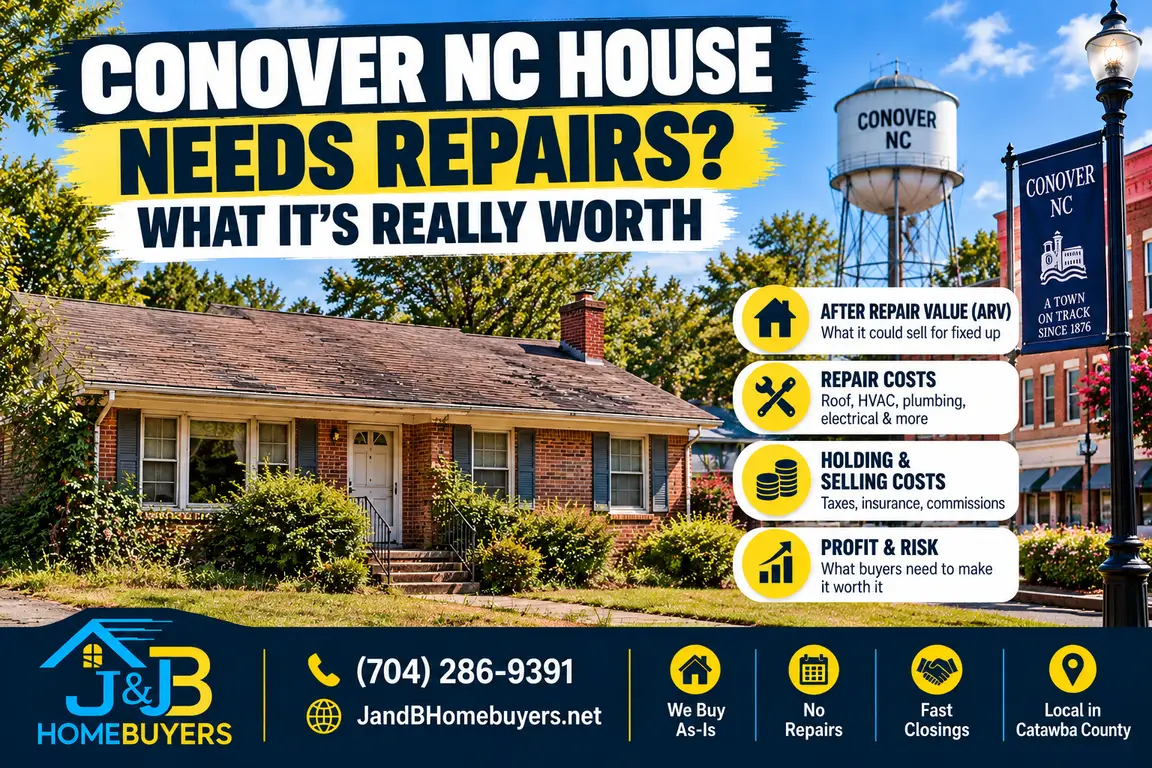
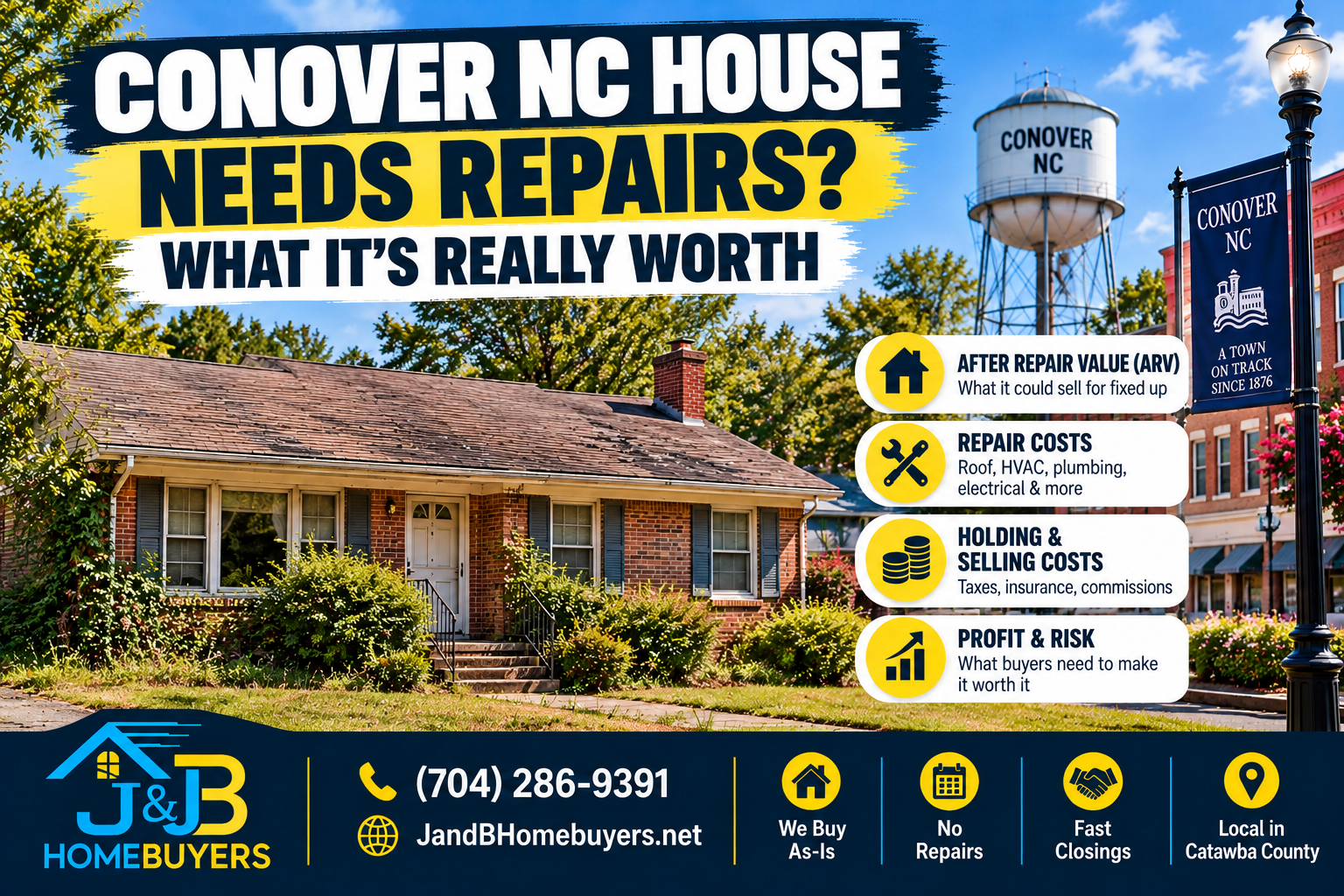
- After-repair value (ARV). What the house would likely sell for once it is fixed up, based on recent sales of similar updated homes nearby.
- Repair costs. What it will take to get the house to that condition. Roof, HVAC, plumbing, electrical, flooring, paint, kitchen, baths, and anything a lender’s appraiser or home inspector would flag.
- Holding and selling costs. Property taxes, insurance, utilities, and loan interest while the work gets done, plus closing costs and agent commissions when the fixed house is resold.
- Profit and risk margin. The amount the buyer needs to make the job worth doing, plus a cushion for surprises behind the walls.
Put together, it looks like this:
As-is value = ARV − repairs − holding and selling costs − profit and risk margin
That is it. There is no secret formula. Some flippers use a quick rule of thumb based on a percentage of ARV, but a percentage is just a shortcut for the same math. What matters is whether each piece is honest.
Where sellers and buyers usually disagree
After-repair value
Sellers often think of ARV as “what my neighbor’s house sold for.” That only works if the neighbor’s house is similar in size, age, and layout, and was in fixed-up condition when it sold. A good ARV uses several comparable sales, close by, from the last several months. In Conover that might mean comparing homes in the same part of town rather than mixing older houses near downtown with newer subdivisions out toward the edges of the city.
Repair estimates
This is where most of the gap comes from. A homeowner thinks “it just needs a roof.” A buyer walks through and sees the roof, plus water damage on the ceiling under it, plus an electrical panel that an insurer may not like, plus old windows. Buyers also price repairs at contractor rates, not weekend-DIY rates, because they have to hire the work out.
Risk
The less anyone knows, the more risk a buyer builds in. A crawlspace nobody has looked at, a foundation crack, or a house that has sat vacant with the water off all add uncertainty. If you can get a contractor’s written estimate or a pre-listing inspection, you take some of that guesswork away, and an honest buyer should tighten up their number.
Listing vs. as-is vs. cash: side by side
There are really three ways to sell a Conover house that needs work. Here is how they compare. We are not putting dollar figures in this table because every house is different, and we would rather you get real numbers for your own house.
| Factor | Fix up, then list | List as-is with an agent | Sell to a cash buyer |
|---|---|---|---|
| Who pays for repairs | You, up front | Buyer, but they negotiate the price down | Buyer |
| Typical buyer | Families using mortgage loans | Investors and some cash or renovation-loan buyers | Investor or direct cash buyer |
| Agent commission | Yes | Yes | No (with a direct buyer) |
| Inspection and appraisal risk | Moderate | High, deals can fall apart | Low, buyer takes it as-is |
| Time to close | Repair time plus market time | Market time | Usually the fastest, seller often picks the date |
| Likely net to you | Highest, if repairs go as planned | Middle | Usually lowest, but the most certain |
Notice that the cash route is usually not the top dollar option. It trades some price for speed, certainty, and not having to do the work. If you have the money, time, and energy to fix the house, you will likely come out ahead fixing and listing.
How to check any as-is offer yourself
You do not need to be an expert to sanity-check an offer. Ask the buyer to walk you through their numbers:
- What ARV are you using, and which sales did you base it on?
- What repairs are you counting, and roughly what does each cost?
- What holding and resale costs are you assuming?
- Who pays closing costs, and are there any fees taken out of my side?
A buyer who will not explain the math is a red flag. So is a buyer who offers a high number up front and then “re-trades” it lower right before closing after an inspection. That is a common move by wholesalers who sign a contract and then try to sell that contract to someone else. We are not wholesalers. Joshua or Jessica walks every house before we make an offer, so the number we give you is the number we plan to close on. If you want a deeper look at what as-is really means legally, read our guide to selling a house as-is in North Carolina.
Conover specifics that affect value
Conover sits in the middle of Catawba County with quick access to I-40, US 70, US 321, and NC 16. It started as a railroad junction town in the 1800s and was chartered in 1876, so you will find a real mix of housing: older homes near the original part of town and newer neighborhoods built as the area grew. That mix matters for value:
- Older homes may have original wiring, older plumbing, and pier-and-beam or crawlspace foundations. Buyers will budget for those systems even if they work fine today.
- Location next to Newton and Hickory means comparable sales can come from either direction. Make sure any ARV uses sales that are truly similar to your house and not just close on a map.
- Schools and commutes matter to retail buyers. Conover is served by both Newton-Conover City Schools and Catawba County Schools depending on the address, so check which district your house falls in when you compare sales.
If you are also weighing nearby areas, we buy in Newton and Hickory too, and the same math applies.
When a cash sale makes sense, and when it doesn’t
We would rather tell you the truth than win a deal you will regret.
A cash sale usually makes sense when:
- The repairs are big (roof, foundation, HVAC, major water damage) and you do not have the cash to do them.
- The house might not pass a lender’s appraisal or inspection, which shrinks your pool of retail buyers.
- You inherited the house, live out of town, or simply cannot manage a renovation.
- You are facing a deadline like a job move, a divorce, or a foreclosure date.
Listing is usually the better call when:
- The house needs mostly cosmetic work like paint, carpet, and cleaning.
- Major systems are in decent shape and the house would pass inspection.
- You have time to wait for the right buyer and can cover the mortgage in the meantime.
If you are in that second group, we will tell you so. Talking to a good local agent is the smart move.
Frequently Asked Questions
How do cash buyers calculate an offer on a Conover house that needs repairs?
Most start with the after-repair value, which is what the house would sell for fixed up, then subtract repair costs, holding and resale costs, and their profit and risk margin. The result is the as-is offer. Ask any buyer to show you each number.
Is a Zillow estimate accurate for a house that needs repairs?
Usually not. Automated estimates assume average condition and cannot see a bad roof, water damage, or old wiring. They can be a starting point for after-repair value, but they are not an as-is value.
Should I fix my Conover house before selling?
If the work is mostly cosmetic and you have the money and time, fixing and listing often nets more. If the repairs are major or uncertain, or you cannot pay for them up front, selling as-is may make more sense.
Do I have to pay commissions or closing costs if I sell as-is to J&B Homebuyers?
No. We are a direct buyer, so there is no agent commission, and we cover normal closing costs. Closings are handled by a North Carolina real estate attorney.
Do you buy houses outside Conover city limits?
Yes. We buy anywhere in Catawba County, including unincorporated areas, plus Cleveland, Gaston, Lincoln and Mecklenburg counties.
If you want real numbers for your house instead of guesses, call or text us at (704) 286-9391. Joshua or Jessica will walk the property, show you how we got to our number, and tell you honestly if listing would put more money in your pocket. You can also start on our Conover NC cash home buyer page.